A leaking shower or tub sends water into the wall, subfloor, and the ceiling below, often for months before it shows. Prompt drying and moisture verification keep a hidden bathroom leak from becoming a rebuild in Seattle homes.

A crew responds, uses moisture meters to trace the leak to the pan, drain, grout, or valve, and maps the wet framing, subfloor, and any ceiling below.
Standing water is extracted, and a small wall or ceiling section is opened where needed to reach the saturated framing and cavity.
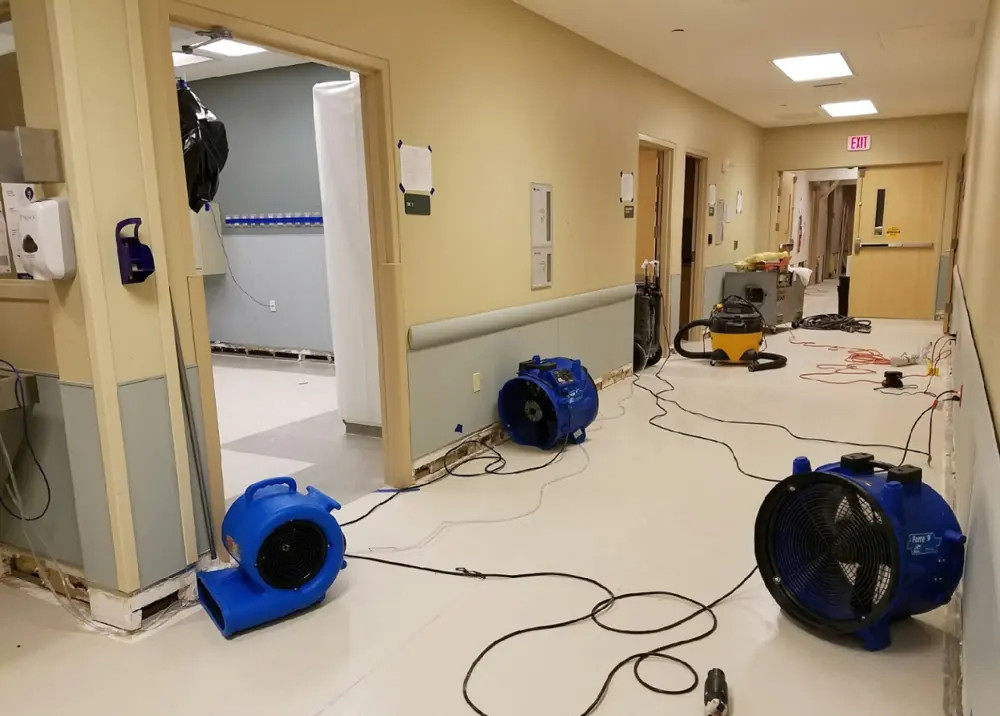
Air movers and dehumidifiers dry the wall, subfloor, and ceiling cavity to a verified target while a qualified contractor addresses the fixture repair.
Readings confirm the affected materials are dry, and the loss is documented with photos for the insurance claim.

While help is on the way, these first steps, done only where it is safe, limit the damage and protect the insurance claim.
Shut the supply off at the source, or close the home's main valve if the source is not obvious. Stopping the flow limits the damage more than anything else.
Switch off electricity to the affected area, but only if the breaker can be reached without standing in or touching the water.
Get a crew dispatched right away. The sooner extraction and drying begin, the more flooring, drywall, and belongings can be saved.
Take photos and a short video of the water and the affected rooms before anything is moved, so the insurance claim starts strong.
Shower and tub leak cleanup in Seattle usually runs from about $900 to $4,500, depending on how long the hidden leak ran, whether it soaked framing, subfloor, and a ceiling below, and how much material must be opened to dry the cavity. A caught-early leak sits low, while months of hidden leaking through a ceiling sits higher. The crew documents moisture readings and photos so the loss can be submitted to the carrier.
Crews reach Seattle and the surrounding Puget Sound communities fast, from Ballard, Fremont, Queen Anne, and Capitol Hill to West Seattle, Shoreline, Burien, Renton, Bellevue, and Kirkland. See the full list on the areas served across Seattle page.
See all areas servedEvery loss is photographed, measured, and logged from the first visit, so the paperwork holds up with the insurance carrier.
Technicians follow recognized IICRC drying standards and prove it with daily moisture readings on Seattle homes, not guesswork.
Emergency dispatch any hour of the day or night, with a real crew on the way across the Puget Sound area, not a callback in the morning.
A real crew dispatched any hour, not a callback in the morning.
Trained technicians following recognized IICRC drying standards.
Truck-mounted, portable, and submersible for any size loss.
The loss is documented and billed to the carrier directly.
The water escapes behind the tile, through a cracked pan liner, or at a drain or valve connection inside the wall, so it goes straight into the framing and subfloor. Nothing shows in the bathroom until the water has traveled far enough to stain a ceiling below or soften a floor, which is why these leaks run hidden for months.
Watch for loose or cracked tile, grout and caulk that keep failing, a musty smell in the bathroom, a soft spot in the floor, and a stain on the ceiling of the room below. In Seattle's humid climate the framing stays damp, so any of these signs is worth a moisture check before the damage spreads.
Sometimes a small, controlled opening is needed to reach and dry framing behind the tile or above the ceiling below. If readings show the cavity is drying and the leak has stopped, the crew keeps openings minimal. The goal is a verified dry structure with as little demolition as possible.
The pan, tile, or valve repair is handled by a qualified contractor or plumber. The crew stops and dries the water damage and coordinates timing so the wall, subfloor, and ceiling cavity are dried and verified around the repair rather than sealed up while still wet.
A sudden failure is more likely covered than a slow leak that went unaddressed, which a carrier may treat as a maintenance issue. The crew documents the source and moisture readings so the claim reflects whether the loss was sudden or the result of long-term seepage.
Seattle crews are on call 24 hours a day, local and fast, and can be on the way within the hour.
Call (206) 984-4939